Showing posts with label CMG. Show all posts

Sunday, March 16, 2014

Computer Modelling Group ( Toronto - CMG ) -- The Big Frack Attack

Computer Modelling Group (CMG.to $27.50) is the leading provider of simulation software used to maximize the economic potential of hard to recover oil and gas reserves.  The company dominates the tar sands market in Western Canada.  It also has strong positions in deep offshore and other heavy oil applications.  Most large pools of petroleum and natural have been found by now.  The ones that remain have become difficult to monetize, moreover, because they exist out in the ocean or in arctic locations.   New land-based discoveries increasingly are being made in shale deposits which require a high degree of technical ability to exploit.  Computer Modelling entered that market a few years ago as U.S. drilling activity accelerated.  The number of customers employing its simulators now is expanding at a rapid pace.  Most have been trying out the technology on a limited basis.  Success has encouraged them to purchase additional licenses and apply the technology to a larger percentage of their overall drilling programs.

The core business remains solid.  Computer Modelling added seven shale customers in the December quarter, bringing the total to 37.  But that segment still represents a small portion of the total business.  The tar sands segment flattened out over the past year due to pipeline shortages, which made it more difficult for smaller operators to acquire financing.  That forced output to be moved by railroad, a more expensive option that itself was capacity constrained.  A series of accidents caused the Canadian government to tighten safety rules on rail car shipping, moreover, exerting further pressure on drilling activity in Western Canada.  Despite all that the major producers have kept up production, and most of those companies are heavy users of Computer Modelling's systems.


Expansion in South America and the Middle East is reinforcing growth.  The company has a close affiliation with Petrobas, Brazil's national oil company.  It also has close ties with leading producers in Colombia and Venezuela.  The latter has fallen behind in its payments to Computer Modelling.  Further delay is possible until the political situation there is resolved.  But the long term outlook in Venezuela remains positive.  Activity is rising in other South American nations, as well, with Argentina in particular preparing to start a major shale drilling initiative.  Middle East demand has been improving in recent years because even there new discoveries have become more difficult to exploit.  The company also is making inroads in Asia.  Shale drilling could become a substantial market in that region over the coming decade.

Competition remains scant.  Schlumberger provides simulation software for conventional oil fields but has been unable to keep pace with Computer Modelling in the high end.  Halliburton used to offer its own heavy oil simulators but now typically re-sells the company's.  A Russian start-up announced a competitive offering in 2013 but that product still hasn't been launched commercially.  Computer Modelling spends 20% of revenue on product development.  It also receives funding from Shell and Petrobas to develop a next generation system that simulates above ground facilities along with the underground drilling operations.  An active consulting team helps customers apply the technology.  It also collects feedback to help upgrade the systems cost effectively.

We estimate sales will advance 12% in the current fiscal year (March) to $77 million.  Earnings appear on track to improve 10% to $.76 a share.  Implementation of the Keystone XL pipeline could reignite Canadian activity over the next few years.  More important, demand by U.S. shale producers is likely to gain momentum as greater experience with the technology is obtained.  The customer count could increase to 60 or more in the U.S. alone.  And those customers probably will buy an expanding number of licenses.  International business is poised to rise in response both to greater conventional (heavy oil) drilling, and the adoption of horizontal fracking methods.  The next generation package recently began field testing by Shell and Petrobas.  That line is likely to generate incremental revenue within 1-2 years if all goes well.  In 2-3 years sales could reach $125-$150 million to produce income of $1.25-$1.50 a share.


( Click on Table to Enlarge )


Monday, June 10, 2013

Computer Modelling Group ( Toronto - CMG ) --

Computer Modelling Group (CMG.to $23.00) reported excellent on target Q4 (March) results.  The company is the leading provider of simulation software used by energy companies to maximize production of heavy oil, tar sands, and other complex reserves.  Customers purchase the technology either on a perpetual basis or year to year.  Perpetual licenses generate more immediate revenue.  Deals that renew annually tend to yield greater lifetime income.  In the latest quarter Computer Modelling booked fewer than normal perpetual deals, resulting in a muted year over year comparison.  But recurring revenue improved by 23%.  Earnings increased by a penny to $.20 a share despite the 33% decline in perpetual license sales.

Demand remains vibrant.  Computer Modelling continues to fare best in the North American market.  Activity in Calgary and North Dakota is continuing to expand at a superior pace.  The U.S. oil fracking market is thriving as costs come down, helped in growing measure by broader software use.  Tar sand costs are falling, as well.  Each of those areas is believed to possess potential reserves that are bigger than Saudi Arabia's.  A price collapse in the oil market remains a significant risk.  In theory worldwide demand for petroleum should be exploding as Third World countries modernize their transportation systems.  The ongoing recession has muted demand, though.  And most OPEC producers depend on their oil income, making it unlikely they'll cut production.  Prices have held up so far because the Obama Administration has virtually eliminated Iran from the picture.  The U.S. and Canada have picked up the mullahs' market share.  Further output increases could start putting pressure on prices, though, unless economic activity rebounds.  Fracking and tar sand costs are declining, so a bigger cushion is being created.  But a big acceleration in sales probably won't emerge until unit volume demand accelerates, forcing energy producers to develop even more challenging fields. 

Natural demand promises to advance in the Middle East.  That's been Schlumberger's province for decades.  And the French oilfield services giant probably will continue to supply a sizable share of the software market over the long haul due to its tight customer relationships.  But even in the Middle East oil has become increasingly difficult to recover.  Computer Modelling has the best technology for exploiting difficult reserves.  The company already is working with Halliburton in North America.  If worldwide demand takes off Computer Modelling could make some direct forays in the Middle East as those kingdoms try to rebuild their own reserve bases.  A collaboration with Schlumberger, while it's unlikely at this point, could develop.

The company's next generation system is slated for launch in the December quarter.  That project was funded equally by Shell and Petrobas, which also supplied part of the engineering team.  Computer Modelling retains exclusive ownership and marketing rights to the technology.  Shell and Petrobas get first shot at using the software.  It should be a pretty big deal.


( Click on Table to Enlarge )

Thursday, February 21, 2013

Computer Modelling Group ( Toronto - CMG ) -- Schlumberger Falls Behind

Computer Modelling Group (CMG.to $22.00) reported Q3 (Dec.) results that were somewhat below our expectation.  The company is the leading provider of simulation software used by energy companies to understand their underground reserves, and manage them for maximum profit.  Computer Modelling's specialty is heavy oil and hard to recover reservoirs.  Competition is provided by Schlumberger and Halliburton, the largest all around oilfield service providers.  Those companies dominated the software market during the "black oil" days, when new discoveries were just giant pools of petroleum that were relatively easy to exploit.  Computer Modelling started up in the 1990s and created advanced mathematics to work on more challenging fields.  Today, those are the only reserves left to find.

Earnings rose a modest 6% in the last quarter to $.17 a share.  Revenues also were up 6% to $16.8 million.  Excluding the company's deal with the Venezuelan national oil company, though, recurring revenue climbed 34%.  Computer Modelling trusts the government of Venezuela to pay its bills.  But its auditors don't.  So the official books don't recognize any accounts receivable.  Revenues equal cash collected.  The bad comparison isn't the result of delayed payments, at least in the December period.  What happened is that Venezuela fell behind last year during the run up to to the elections.  Then they made up for it in the year ago quarter.  So this year's comparison was muted.

Referrals from Halliburton continue to rise.  That company still has a terrific collection of customers with black oil reserves.  They continue to be served by Halliburton's in-house software.  When it comes to new drilling, though, Halliburton can't even give it away.  Computer Modelling's technology is superior.  The rate of return on the technology is far beyond whatever it might be worth to get Halliburton's product for free.  So Halliburton has started to license Computer Modelling's products, figuring it will keep its customers happy and make up the difference by selling all its other products and services.

Schlumberger still has not joined forces with the company.  It hasn't come out with a competitive product, either, from a technology standpoint.  And its top software engineer and product manager recently left the company, casting doubt on the likelihood a big breakthrough is coming soon. 

The offshore project could finish by the end of the year.  That effort continues to be funded 33%-33%-33% along with Shell and Petrobas.  Computer Modelling retains 100% of commercial sales potential to other companies.  The company's partners will get first use of the software.  The structure of the technology allows ample plug-in opportunities.  Shell and Petrobas are developing quite a few of those proprietary programs, which probably won't be made available to their competitors.  Over time, though, word gets around, and those competitors may write their own.

Computer Modelling remains a phenomenal company.  Gross margins are sufficient to pay for aggressive marketing, high levels of product development, and plentiful dividends.  The executives running the company are approaching retirement age.  So a buyout is possible.  But Computer Modelling has a clear cut runway to 2020, perhaps farther.  If it remains independent above average growth could persist as the new product kicks in, existing customers expand, Halliburton referrals keep rising, and Schlumberger throws in the towel and licenses the software, too. 

( Click on table to enlarge )

Monday, January 7, 2013

Computer Modelling Group ( Toronto - CMG ) -- Momentum Continues

Computer Modelling Group (CMG.to $21.50) appears on track to report excellent on target Q3 (December) results.  The company is the leading provider of simulation software used to model energy reservoirs so that production is maximized.  Demand is rising because new deposits have become increasingly difficult to exploit.  A wide range of enhanced recovery technologies have reached the market in recent years, making it more cost effective to extract those reserves.  Complexity has grown, as well, requiring more computer horsepower to analyze the best route to take.  Competition is provided by Schlumberger and Halliburton.  Those companies offer less robust products that originally were built in the "black oil" days, when drilling required simpler techniques.  Schlumberger is continuing to offer its own product line, often without charge, to try to retain marketing control of its accounts.  Many customers are gravitating to Computer Modelling's superior technology, nonetheless.  Halliburton now licenses the company's key products for its consulting group.  That provides a direct revenue contribution.  End users often buy Computer Modelling licenses once Halliburton's consulting efforts finish, giving the company access to a larger customer base.

Existing customers are purchasing additional licenses, too.  Demand is vibrant in all geographic markets.  Volume is responding to the combination of steady selling prices for oil and declining production costs.  Enhanced recovery techniques traditionally were expensive and unreliable.  Computer Modelling's software has played a role in driving costs down, and production up.  Companies that deliver those enhanced recovery and fracking methods have boosted price performance dramatically, moreover.  Difficult to recover reserves like tar sands, shale, and heavy oil are becoming increasingly economical to produce.

The renewal rate remains in the 95%-98% range.  Occasionally a license is not renewed after a project ends.  But most customers retain the technology and just move the expertise to a new target.  Computer Modelling has been transitioning its customer base from perpetual to annual licenses for several years.  Some still prefer the perpetual format, though.  Those deals cause quarterly results to fluctuate, due to the higher dollar amounts involved.  The underlying trend in annuity revenue continues to advance at a 15%-25% rate.  Profitability exceeds 50% pretax.  A large portion of income is paid out as cash dividends.  Our estimates are unchanged.

( Click on Table to Enlarge )

Wednesday, October 17, 2012

Computer Modelling Group ( Toronto CMG ) -- Market Share Expands

Computer Modelling Group (CMG.to $20.00) appears on track to report excellent on target Q2 (September) results.  Energy prices remain at elevated levels, providing the cash flow to support new development.  And most of the reserves that are being identified these days are difficult to extract.  Computer Modelling is the leading provider of simulation software used by energy companies to maximize production of tar sands, heavy oil, shale, and other challenging targets.Competition is provided by Schlumberger and Halliburton.  Those companies have a large installed base of customers who use their software for so-called "black oil" deposits, which are relatively straightforward to extract.  Both also offer high end solutions.  Those products are less powerful and comprehensive than Computer Modelling's.  As a result, users often spend enormous sums on consultants to muscle the work through.  A growing number of oil and gas developers are switching to Computer Modelling while maintaining their other business relationships with Schlumberger and Halliburton.

At a recent trade show Schlumberger and Halliburton didn't advertise their high end simulators.  Both products remain on the market.  The two giants are becoming resigned to working with Computer Modelling in high end applications, though.  That trend promises to boost financial performance in upcoming periods, particularly in international markets where large national oil companies typically have relied on the majors for one stop shopping.

Our estimates are unchanged.  Future growth could be amplified by a next generation system that is slated for commercial release in late 2013.  Shell and Petrobas are sharing the development cost.  Those companies will obtain first crack at the technology.  But Computer Modelling will retain 100% of the marketing rights with no obligation to pay royalties or any other reimbursement.

( Click on Table to Enlarge )

Tuesday, September 4, 2012

Computer Modelling Group ( Toronto - CMG ) -- Energy Prices Reinforce Demand

Computer Modelling Group (CMG.to $18.00) appears on track to produce excellent on target Q2 (September) results.  The year ago period was affected by a temporary decline in perpetual software license sales.  Those generate higher immediate revenue than year to year licenses.  The latter often are more profitable over time, though.  A strong comparison is likely this year.  Demand remains robust because energy prices are high enough to justify new development projects, most of which are complicated and are candidates for the company's technology.  Shale oil, tar sands, heavy oil, and deep offshore programs have begun to dominate the industry's exploration agenda.  It's unknown what the split between annual and perpetual licenses will look like in the current period.  Even if perpetuals fall off again, a solid showing is expected. 

The long term outlook is positive.  Competition remains far to the rear from a technology standpoint.  Shlumberger and Halliburton are resorting to bundling other products with their offerings.  Many customers rebuff the offers because Computer Modelling's technology provides unique capabilities which generate paybacks far beyond any discounts the majors might offer.  Marketing is being beefed up in the Middle East to unlock that geographic market.  Halliburton and Schlumberger have controlled that segment due to longstanding relationships, but new reserves are becoming more difficult to develop even in the Middle East.  A sales breakthrough could emerge over the next 1-2 years.  Venezuela will have national elections later this year.  The incumbent party has boosted spending to help win reelection.  Much of those funds have been sourced from the energy industry.  So Computer Modelling may experience some slow payments as a result.  Venezuela always has paid up in the past, however.  So the potential for write-offs appears slim.

Our full year estimates are unchanged.

( Click on Table to Enlarge )


Wednesday, August 8, 2012

Computer Modelling ( Toronto - CMG ) -- Positive Outlook

Computer Modelling (CMG.to $18.00) reported excellent on target Q1 (June) results.  The company is the leading provider of reservoir simulation software used by energy producers to retrieve heavy oil and other difficult deposits.  Licenses are sold on an annual and perpetual basis.  The latter are more unpredictable.  Most customers renew the annual licenses at a high rate.  In the June period perpetual sales dipped compared to the year ago, holding the overall year to year revenue gain to 3% ($16.5 million).  Annual revenues ($13.2 million) climbed 46%, however.  Non-GAAP income slid 6% to $.17 a share.  A large perpetual contract was finalized in early July.  Additional large contracts are in the pipeline.  Perpetual business is likely to rebound to normal levels, leveraging the sustained growth in annual licenses.  We are maintaining our full year earnings estimate at $.80 a share. 

The next generation DMRS software program appears to be back on track.  Computer Modelling is developing that technology in conjunction with Shell and Petrobas.  The giant companies' engineers steered the effort in a highly technical direction that made it hard for end users to operate.  Computer Modelling stepped in during the June period to shift gears towards a more user friendly format.  The streamlined software is functioning better.  And a less complicated user interface is being implemented.  Field testing is likely to start before long.  Commercial sales are expected by the end of next year.

Competition continues to fall behind.  Schlumberger has begun giving away its software, to little avail.  Halliburton recently licensed Computer Modelling's offering for shale gas applications.  There are a handful of small niche software providers but nobody measures up to the company's expertise and customer support.  Margins are likely to remain elevated.  Growth is poised to be sustained at above average rates.

( Click on Table to Enlarge )

Friday, May 25, 2012

Computer Modelling Group ( Toronto - CMG ) -- Momentum Continues

Computer Modelling Group (CMG.to $17.75) reported excellent on target Q4 (March) results.  Non-GAAP earnings advanced 36% to $.19 a share.  Revenues improved 20% to $17.2 million.  All figures are in Canadian dollars.  Perpetual software license revenue declined 13% to $3.4 million.  That segment tends to bounce around from period to period.  Annual subscriptions generally are more consistent.  That segment was responsible for the quarter's growth.  The next generation DRMS software project experienced technical problems and probably won't be launched for another two years.  Computer Modelling is working with Shell and Petrobas on that effort.  Meantime, though, the company's core reservoir simulation line is continuing to build momentum.  Computer Modelling is the leader in the hard to recover end of the market, which is the industry's fastest growing area.  Fiscal 2012 (March) earnings rose 30% to $.65 a share.  Revenues improved 18% to $61.0 million.  Our fiscal 2013 estimates are unchanged at $.80 a share and $70 million, respectively.  The quarterly cash dividend was increased to $.16 a share.  An extra $.10 a share will be paid in June.


( Click on Table to Enlarge )


Monday, February 27, 2012

Computer Modelling Group ( Toronto - CMG ) -- Market Share Expands

Computer Modelling Group ( CMG.to $16.00) reported excellent on target Q3 (December) results.  Revenues improved 32% to $15.9 million.  (All amounts in Canadian dollars.)  Earnings (excluding non cash stock option expense) rose 45% to $.16 a share.  Computer Modelling is one of the three leading providers of reservoir management software that allows energy companies to simulate different strategies for maximizing the return on their oil discoveries.  Schlumberger and Halliburton still dominate the so-called "black oil" segment, reserves that are relatively easy to retrieve.  Computer Modelling is the leader in hard to recover fields including tar sands, shale, deep offshore, and other heavy oil deposits.  Since most of the oil that's easily lifted already has been discovered most new discoveries fall into the company's bailiwick.  Rising worldwide oil prices are making it affordable to pursue those challenging fields, moreover.  Growing demand for petroleum, fueled by emerging markets and the economic recovery, is reinforcing the trend.

A new product line entered field testing in the December quarter.  The "Dynamic Resource Modelling Software" line has been in development for five years.  Computer Modelling split the R&D cost equally with partners Shell and Petrobas.  Those major oil companies now are testing the system on some deep offshore reserves.  Once the technology is finalized Computer Modelling will retain 100% of the marketing rights along with 100% of the profit potential.  The software simulates all of a project's above ground operations in addition to its oil deposits.  Commercial sales could start later in calendar 2012.

Meantime, demand for the core simulation products remains vibrant.  Revenues were bolstered in Q3 (December) by cash payments received from the Venezuelan national oil company.  That's a large customer that Computer Modelling has a long history with.  But payments rarely are made when invoiced.  So revenues only are recognized when the checks clear.  Bad debts never have been an issue.  This time the Venezuelans prepaid, so some revenue was borrowed from upcoming quarters.  Despite that revenue acceleration the outlook for further gains remains strong.  Computer Modelling broke into the Middle East market in Q1 (June) and while the company hasn't booked any additional business there, the pipeline of potential opportunities is large and growing.  Even in the Middle East new oil reserves are becoming more difficult to extract.  Tar sand demand remains solid in Canada.  Shale oil demand in the U.S. is expanding.  Foreign business is climbing, as well, both onshore and off.  And deepwater drilling in the U.S. could start to pick up again before long.

Our estimates are unchanged.  Income could reach $.65 a share in fiscal 2012 (March) and rise 23% next year to $.80 a share.  Computer Modelling sells its technology as either perpetual or annual licenses.  The latter typically earn the company more money over the long haul but produce less upfront revenue.  Exact financial numbers will depend on the split between the two pricing models.  The quarterly dividend recently was lifted 18% to $.13 a share.  In the past the company has paid an extra dividend during the first quarter (June).

( Click on Table to Enlarge )


Tuesday, November 15, 2011

Computer Modelling Group ( Toronto - CMG ) -- Turns the Corner on Schlumberger

Computer Modelling Group (CMG.to $13.50) reported excellent on target Q2 (Sept.) results.  The company is the leading provider of simulation software used by energy companies to maximize output at existing oil and gas fields.  Computer Modelling provides the industry's best mathematics and user interfaces, helping customers figure out the most effective way to exploit a target.  The industry originated in the 1980s with the advent of high performance computers made by Silicon Graphics.  Then Schlumberger and Landmark Graphics developed software that helped companies process seismic data and other information, so they could find promising areas to drill.  Landmark ultimately was acquired by Halliburton.  Computer Modelling came onto the scene in the 1990s with an emphasis on reservoir development, particularly in challenging applications like heavy oil and enhanced recovery.  The giants dominated the market through the mid-2000s and still control most of the so-called "black oil" segment today.  Those are the simplest fields to drill, like in Saudi Arabia.  There still might be some giant pools of sweet crude in the Arctic Sea.  Other than that, though, the easy stuff has been found.  These days new fields still have tremendous potential.  But they're locked into tar sands, and shale formations, and other difficult to exploit locations.  Demand for Computer Modelling's technology is accelerating as the energy industry has shifted its attention to those high potential but complex sites.

Earnings were flat at $.12 a share (excluding stock option expense).  Reported sales declined 10% to $12 million.  That doesn't sound too impressive.  But unit volume was up by approximately  20%.  Backlog expanded.  And a new product line with enormous potential finished up in R&D and will enter beta testing in Q3 (December).  Computer Modelling sells is software either on a perpetual basis or as an annual subscription.  In the latest quarter the perpetual component virtually disappeared.  Recurring revenues advanced 18%.  That figure was understated by 6%, moreover, since Computer Modelling reports results in Canadian Dollars but earns most of its income in U.S. money.  The looney went up in the period.  Costs were affected by the end of the company's relationship with "The Foundation."  That's a non-profit financed by 13 oil companies that had been paying 50% of Computer Modelling's new product development expenses. It also used to own 40% of the company's stock.  Those shares were sold last year.  The R&D payments ended in Q1 (June).

Not to worry.  Pretax margins remain above 50%.  And Shell and Petrobas each are continuing to finance 33% of the R&D project (as they have for the last five years), while granting Computer Modelling 100% ownership of the software.  That next generation "Dynamic Reservoir Modeling System" will allow operators to simulate all their above ground operations in addition to their drilling activities, maximizing a project's total return on investment.  Shell and Petrobas will get first shot at the technology.  But once commercialization begins, probably late in calendar 2012, Computer Modelling will retain any earnings without recourse.

Demand is accelerating.  Computer Modelling recently broke into the Middle East market (click on "Labels" below).  Business also is vibrant in South America, the U.S., Asia, and Africa as more heavy oil and other enhanced recovery type projects come on line.  Demand in Canada has plateaued for the time being due to the U.S. State Department's decision to block a pipeline designed to transport tar sand crude to refineries along the Gulf of Mexico.  Well financed operators in Canada are continuing to develop their properties.  But a number of smaller companies have scaled back.  An alternative pipeline to the West Coast is being contemplated, to send the heavy oil to China.

Shale oil and shale gas represent large opportunities.  A lot of shale operators originally eschewed simulation, figuring they couldn't miss.  Simulation has become increasingly popular with experience.  The technology is helping producers target wells more productively.  Demand is starting to jump as a result both in shale gas and shale oil plays.  The international shale market remains in an early stage of development.  But tremendous potential is believed to exist, particularly in Eastern Europe and China.  Computer Modelling is likely to benefit from the trend, similar to the way Carbo Ceramics has in the proppant industry.

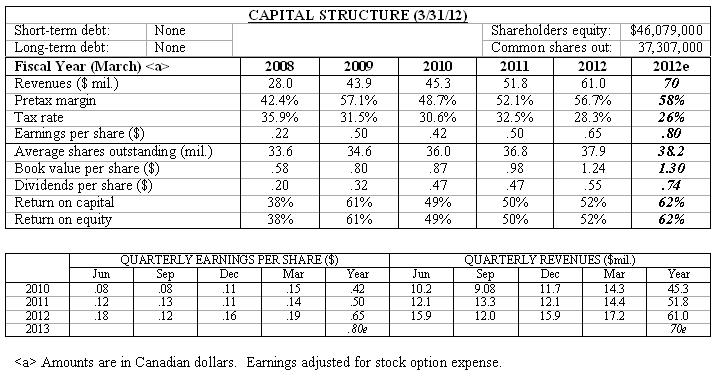
We estimate income will rise 28% this year (March) to $.65 a share.  The exact number will depend on the split between perpetual and annual licenses.  Next year $.80 a share represents a realistic target.  Long term growth of 20%-30% appears sustainable, bolstered by the new DRMS product line.  Technology trends remain favorable.  Advances in parallel processing have made simulation software increasingly powerful and easy to use.  The trend towards hard to recover energy sources promises to reinforce demand.  Market share gains already are being realized.  The company's two main competitors, Schlumberger and Halliburton, have long viewed simulation as a complementary product line serving a niche market.  Customers still rely on those giants for a wide range of oilfield services.  Increasingly, though, they are selecting Computer Modelling's best of breed simulation technology.

( Click on Table to Enlarge )

Thursday, August 25, 2011

Computer Modelling Group ( Toronto - CMG ) -- Breaks Through in the Middle East

Computer Modelling Group ( CMG $13.00) reported excellent on target Q1 (June) results.  The company is a leading provider of reservoir simulation software that helps energy companies extract reserves most efficiently.  Its expertise is in heavy oil, tar sands, and other challenging deposits.  Competition is provided by Halliburton and Schlumberger, which provide software better suited to "black oil" reserves that are easier to lift.  Those companies are major energy service providers that enjoy strong marketing connections to many large customers, particularly national oil companies.  In the June quarter Computer Modelling made the largest sale in its history to a Middle Eastern national oil company, displacing Schlumberger.  The deal drove earnings up directly by 50% to $.18 a share.  Creation of such a prominent reference account could pave the way for transactions with additional Middle East customers in future periods. 

Demand from tar sand producers in Canada remains intact despite recent declines in worldwide energy prices.  Technology improvements, some provided by Computer Modelling, are keeping costs on a downward sloping curve.  Environmental objections are being overcome.  And construction of a pipeline to get the oil to world markets is likely to begin fairly soon.  The Canadian government would prefer to direct the pipeline to the United States.  The U.S. Environmental Protection Agency has raised a wide range of objections to the project, though, which probably won't be resolved before the 2012 election.  Whether the Canadians will wait that long remains to be seen.  The Chinese government appears willing to fund an alternative project ending at the west coast, the plan being to ship the oil across the Pacific.  Either way, production is likely to keep expanding in the Alberta tar sands region.

The "DRMS" offshore software project is nearing completion.  Shell and Petrobas provided two thirds of the funding for that effort, even though Computer Modelling will keep 100% ownership of the technology.  The two majors will get to use the software first, and they get the right to market it on a commission basis, as well.  Shell and Petrobas plan to test the software in their own operations starting in Q3 (December).  Commercial sales are expected to begin late next year.

For fiscal 2012 (March), we are raising our earnings estimate by a nickel to $.65 a share (+27%).  Excluding any DRMS contribution gains of 15%-20% appear sustainable in subsequent years.  If the company makes further inroads in the Middle East substantially faster growth could emerge.  The odds of that happening appear favorable.  The DRMS line is a wild card, but it too appears to offer terrific potential.  Downside risk is muted by the 4% cash dividend. 

( Click on Table to Enlarge )


Monday, August 8, 2011

Computer Modelling Group ( Toronto - CMG ) -- Order Rate Improving

Stock price reflects 2-for-1 split.

Computer Modelling Group (CMG $10.75) appears on track to report excellent on target Q1 (June) results.  Orders for the company's energy development simulators remain vibrant, despite the recent decline in oil prices.  Project activity hasn't diminished in Canada.  And the company is continuing to make competitive inroads in other geographies.  Computer Modelling is the leading provider of reservoir simulation software for heavy oil, oil sand, and other challenging targets.  New discoveries are becoming increasingly more difficult to recover, boosting interest in the company's technology.  Financial results might be less dynamic than Computer Modelling's unit volume gains due to currency factors.  Most of the company's personnel (costs) are in Canada, while more than 70% of sales are priced in U.S. Dollars.  The Canadian currency has been relatively stronger this year, creating a negative translation effect.    Even so, pretax margins are likely to remain in the 45%-50% vicinity.

The DRMS software will enter beta testing in Q4.  That technology simulates the above ground operations at energy projects, allowing customers to maximize all aspects of the work, not just extracting the oil.  Petrobas and Shell are footing the bill for the development work and will get first shot at the software.  But Computer Modelling will retain all rights to the software and will be able to market it to anyone once it is commercialized in 2012.  Final work is focusing on integrating the simulators with customer databases and other computer resources, simplifying the user interfaces so engineers can use the technology without extensive training, and speeding up the processing speed even more.  In laboratory testing the new programs already run faster than the company's existing products.

Results will be affected by mix between perpetual and annual licenses.  Perpetual buyers spend more up front.  Annual deals generate higher recurring revenue.  Either way, the total number of licenses in force is poised to keep advancing.  Demand for oil is likely to remain robust at least for several more decades.  Computer Modelling is a key player in developing new reserves to meet that projected demand.  The new product line could amplify results further.  The shares remain a solid investment. 

Thursday, May 26, 2011

Computer Modelling Group ( Toronto - CMG ) -- Q4 Results

Computer Modelling Group (Toronto - CMG $28.00) reported Q4 (March) results that were below our expectation.  The company prices its energy simulation software either as a perpetual license or on a year to basis.  More customers elected the annuity format which provided less upfront revenue.  Unit volume was on target.  The recurring fees will enhance future reporting periods.  Earnings were down 10% at $.28 a share (excluding non cash stock option expense).  Sales were flat at $14.4 million (Canadian).  For the entire fiscal year earnings rose 16% to $.99 a share.  Revenues improved 14% to $51.8 million.   Consulting was the fastest growing segment, although it only represented 16% of total sales.  Computer Modelling has upgraded its technology substantially over the past two years, adding functionality that many users need help with to implement.  Those engagements usually lead to license sales.  License sales also are benefiting as different divisions within large companies adopt the technology. 

Long term growth promises to remain vibrant.  Almost all new energy discoveries are difficult to develop, and candidates for Computer Modelling's technology.  Halliburton and Schlumberger continue to offer simulators for conventional fields but have been unable to catch up in the high end segment.  Worldwide energy demand continues to rise, fueled by emerging economies.  And even at current price levels oil and natural gas provide far superior price performance compared to alternative sources.  A second line will be introduced later this year, focused on above ground facilities.  Those simulators will enable customers to maximize productivity for their entire projects.  The company is partnering with Petrobas and Shell.  Computer Modelling will retain all rights to the technology even though it only paid a third of the development cost.  Petrobas and Shell will get first crack at putting it to use.  Substantial leverage is possible by selling the new line to existing customers and bundling it with existing products when making new sales.

( Click on Table to Enlarge )


Sunday, February 20, 2011

Computer Modelling ( Toronto - CMG ) -- Follow-up Report

Computer Modelling (CMG $25.00) reported Q3 (December) results that were somewhat below our expectation.  The main reason for the shortfall was a higher concentration of annual software license sales compared to perpetual licenses.  The company gives customers a choice of payment plans.  More took the year to year approach in the December period, requiring a lower upfront outlay.  Non-GAAP income slipped 9% to $.21 a share.  (All figures are shown in Canadian Dollars.)  Revenues increased 3% to $12.1 million.  Deferred revenue increased 17%, presenting a more accurate picture of the company's underlying growth rate.  Product development and marketing costs expanded in the period, pressuring margins to a degree.  Pretax income remained at 47% of sales.  The R&D line went up as Computer Modelling began putting on the final touches to its next generation software line.  Sales from that product will pyramid on top of the company's existing packages.  Computer Modelling improved its current products, as well, separating itself even further from the competition.  Selling efforts in the Middle East haven't borne fruit to date.  Political uncertainty may slow down those initiatives.  But new petroleum finds are becoming increasingly complex to analyze, even in the Middle East.  Demand is likely to emerge because Computer Modelling's software has been proven superior to Schlumberger's by a wide margin in those kind of applications.

We are maintaining our full year (March) earnings estimate at $1.10 a share.  The trend towards annual licenses may continue, in which case a lower number probably will be reported.  Those deals would lay the groundwork for greater recurring income in the future, though.  Rising energy prices promise to bolster demand over the intermediate term.  Tar sands, shale oil, shale gas, deep offshore, heavy oil, and other complex formations are where the action is when it comes to new discoveries.  As those fields get the go ahead demand for Computer Modelling's software is sure to follow.  The pipeline fiasco now afflicting the U.S. oil market may exert a slight restraint on activity.  But the U.S. has become one of the company's smaller markets, so the net impact shouldn't amount to too much.  Reported results also will be effected negatively if the U.S. Dollar declines materially, since two thirds of revenue is denominated in that currency while most costs are paid in Canadian Dollars. 

Financial results could accelerate sharply after the new software line is introduced.  The technology was field tested last year.  The software currently is being enhanced to run faster with better user interfaces.  Commercial launch is expected later this calendar year.  With a major new product in the wings, demand still growing rapidly for the company's core product, and no direct competition in sight, these shares continue to hold exceptional appreciation potential.  Meantime, the shares are yielding a 3%-4% cash dividend.

( Click on Table to Enlarge )


Saturday, January 15, 2011

Computer Modelling Group ( Toronto - CMG ) -- Follow-up Report

Computer Modelling Group (CMG $25.00) appears on track to report excellent on target Q3 (December) results.  The company is the leading provider of simulation software used by energy producers to exploit heavy oil, tar sand, and other complicated reserves.  Computer Modelling is gaining market share from Schlumberger, which still leads in the conventional market, because most of the easy to produce oil already has been found.  New discoveries are increasingly complex and require the company's high performance software.  Demand is rising across the board in response to escalating petroleum prices, which recently climbed above $90 a barrel.  Anything higher than $75 per barrel generally causes the pace of exploration to gain momentum.  Business remains vibrant in Computer Modelling's established markets.  The company has started to penetrate new accounts, as well, which used to rely exclusively on Schlumberger or their own internal technologies.  Geographic expansion is materializing, too, in response to beefed up marketing efforts.  Schlumberger has not responded with competitive high end products yet, and it appears that a major development effort is not underway.  Start-up competition has not emerged, either, and the likelihood of anyone new catching up at this point has become a dim prospect.  Computer Modelling is applying the finishing touches on a more comprehensive next generation system, which promises to lengthen its competitive lead after it is commercially introduced, perhaps as early as 2012.  Meantime, orders are pouring in as the energy industry prepares for a sustained increase in petroleum demand as the Third World matures over the next few decades.  Income is poised to keep rising at a fast pace.  Much of that is likely to be paid out as cash dividends, moreover, providing shareholders with a superior return comprised of both income and appreciation.

( Click on Table to Enlarge. )

Friday, November 19, 2010

Computer Modelling Group ( CMG - Toronto Exchange ) - Follow-up Report

Computer Modelling (CMG $21.00 Canadian) reported excellent on target Q2 (September) results.  Sales advanced 47% to $13.3 million.  Earnings climbed 73% to $.26 a share, excluding non cash stock option expense.  The company sells its reservoir modelling software to the energy industry both as a perpetual license and on a recurring year to year basis.  Up front revenue is greater on perpetual sales.  That format does generate some recurring revenue in the form of annual maintenace contracts, however, ensuring customers they receive technology upgrades when they become available.  New unit sales typically are tied to new development projects.  Computer Modelling doesn't break out unit volume but it appears activity picked up sequentially in Q2, bolstered by stronger petroleum prices and improving access to capital.  Results also benefitted from a modest pick-up in perpetual license sales, especially compared to the first quarter when they were practically zero.  Year to year renewals still account for a majority of the business.

The next generation DRMS ("Dynamic Resource Management System") went into service in Q2.  The initial applications will be at sites being developed by Computer Modelling's software partners (Shell and Petrobas).  Those energy giants are each paying one third of the product development costs, although Computer Modelling will retain 100% rights to the technology.  The partners get first crack at the system, though, and that lock-up probably will extend for awhile.  Commercial sales to outside customers are likely to provide a major boost to results through the decade.  But that contribution is likely to modest over the next year or two as Shell and Petrobas fine tune the software and reap the initial benefits for themselves.

The core operation remains in a high growth mode.  New oil discoveries are being made, but they have become increasingly complicated to exploit.  Most of Computer Modelling's sales continue to come from North America.  Interest is building in the Middle East, Asia, and Africa, however.  Those markets promise to keep results marching higher well into the future.  We estimate fiscal 2011 (March) income will reach $1.10-$1.30 a share (Canadian) on sales of $55-$60 million.  Further improvement is likely next year, especially if inflationary pressure increases in the energy complex.  By then the DRMS line should start making a substantial contribution.  Note - Computer Modelling's stock also trades in the U.S. under the ticker symbol CMDXF.  Trading is more liquid in Toronto.

(Click on table to enlarge)
                                                                                                                      

Tuesday, October 12, 2010

Computer Modelling ( CMG - Toronto Stock Exchange )

Computer Modelling Group (CMG $18.00 Canadian) is the leading provider of simulation software used by energy companies to model underground reservoirs.  Customers rely on the technology to test a range of possible production strategies so that the most efficient method is identified.  The process continues for as long as the field remains productive.  Conditions change over time as reserves are brought to the surface, causing new approaches to become better solutions.  Schlumberger and Halliburton, the two leading oilfield services companies the world, dominated the industry since its inception in the mid-1980s.  The advent of supercomputers made by Silicon Graphics and Cray Computer made it feasible to perform the analysis on computers.  Schlumberger and Halliburton focused on so-called "black oil" reservoirs, which involved relatively straightforward drilling programs.  Computer Modelling entered the fray a decade later with an emphasis on hard to produce reserves, among them heavy oil and tar sand projects.  The company has continued to invest aggressively in the technology, leveraged by third party funding relationships that leave Computer Modelling with 100% ownership of the intellectual property. 

Growth is accelerating as new oil discoveries become increasingly complex.  Computer Modelling is gaining market share as exploration moves towards reserves that are more difficult to drill.  Software sales tend to be made on a project by project basis, and the programs tend to stick with each project until the field is completely exploited.  Since most of the easy to produce oil already has been discovered, new business is gravitating towards more complicated fields.  Computer Modelling's large competitors still control a number of major oil company accounts (especially the national ones), so despite its superior technology the company still holds a minority share of the market.  But that percentage has been rising over the past decade as more geophysicists familiarize themselves with the software, and a growing number of top tier energy companies sign on as customers.

A new product line offers additional leverage.  Computer Modelling has been developing a more comprehensive system in combination with Shell and Petrobas over the past four years.  The technology encompasses all of a project's above ground facilities in addition to reservoir modelling, and appears to be ideally suited for deep offshore drilling.  Petrobas plans to put the software to the test on an unnamed project starting this week.  The company recently raised $75 billion to develop the world's largest offshore oil discovery in Brazil.  That might be it.  Shell is starting a project of its own.  If the software performs as expected further expansion in those two companies is likely.  Commercial sales to other oil companies probably would follow in future years.

Earnings are rebounding following a temporary decline in fiscal 2009 (March '10).  Energy companies around the world delayed projects last year due to the recession and the uncertainty that created about the future of energy prices.  Now that crude has stabilized in the $70-$80 per barrel range, and interest rates remain low, many of those projects have gotten underway again.  Computer Modelling netted $.85 a share (Canadian) last year, down from $.99 a share the year before.  (Please refer to our "Accounting Notes" section.)  In the current fiscal year, ending next March, we estimate income will rebound to $1.10-$1.30 a share.  The company sells licenses on an annual basis, and as perpetuals that customers own forever.  Annuals sell at about 40% of the perpetual price.  Perpetual licenses generate annual maintenance fees equal to 20% of the selling price, entitling the owner to software updates as they come available.  Either way, the company creates a long term recurring revenue stream.  Perpetual sales generate more income right away, though.  So this year's exact income figure will hinge on how the license sales are split up.

We estimate total revenues will rise 21%-33% to $55-$60 million.  In the first quarter (June), earnings advanced 50% to $.24 a share on an 18% revenue increase ($12.1 million).  In 2-3 years earnings could reach $1.75 a share on sales of $70 million.  Applying a P/E multiple of 25x suggests a target price of $45 a share, potential appreciation of 150% from the current quote.  Note - The stock also trades in the United States on the Pink Sheet exchange under the ticker symbol CMDXF.